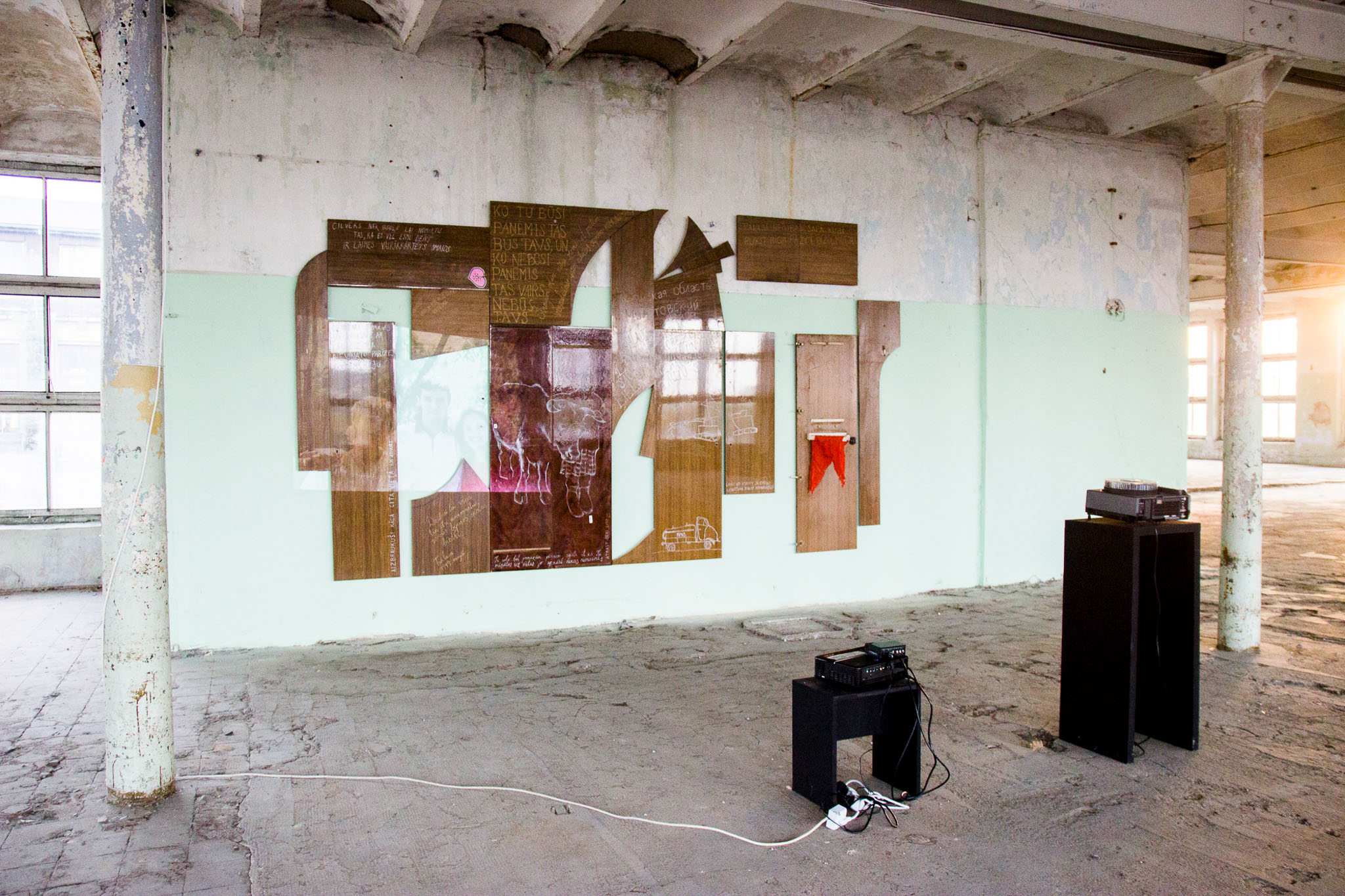
“Our Lives are Infinetely Versatile and Full of Interesting Affairs”
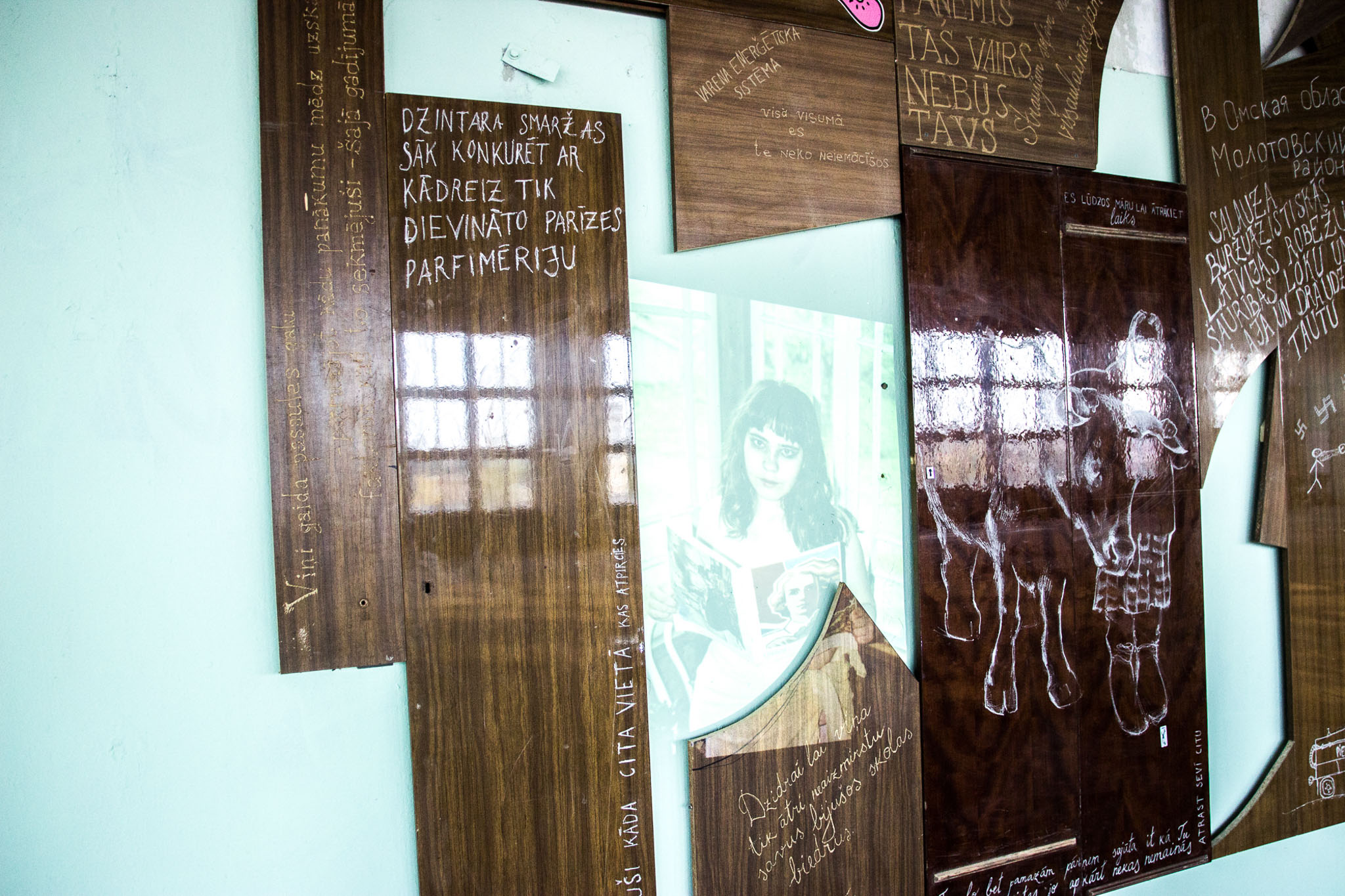
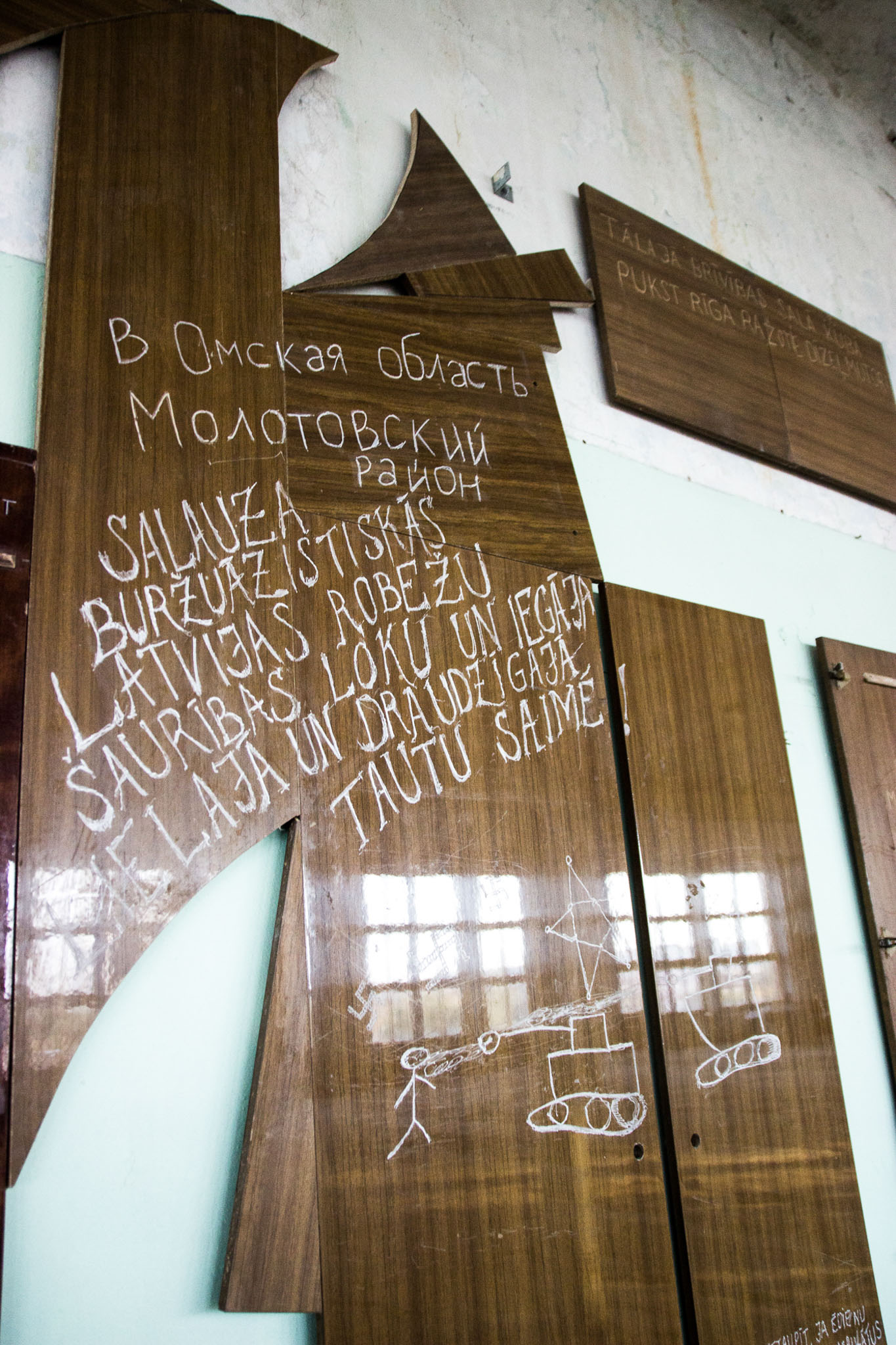
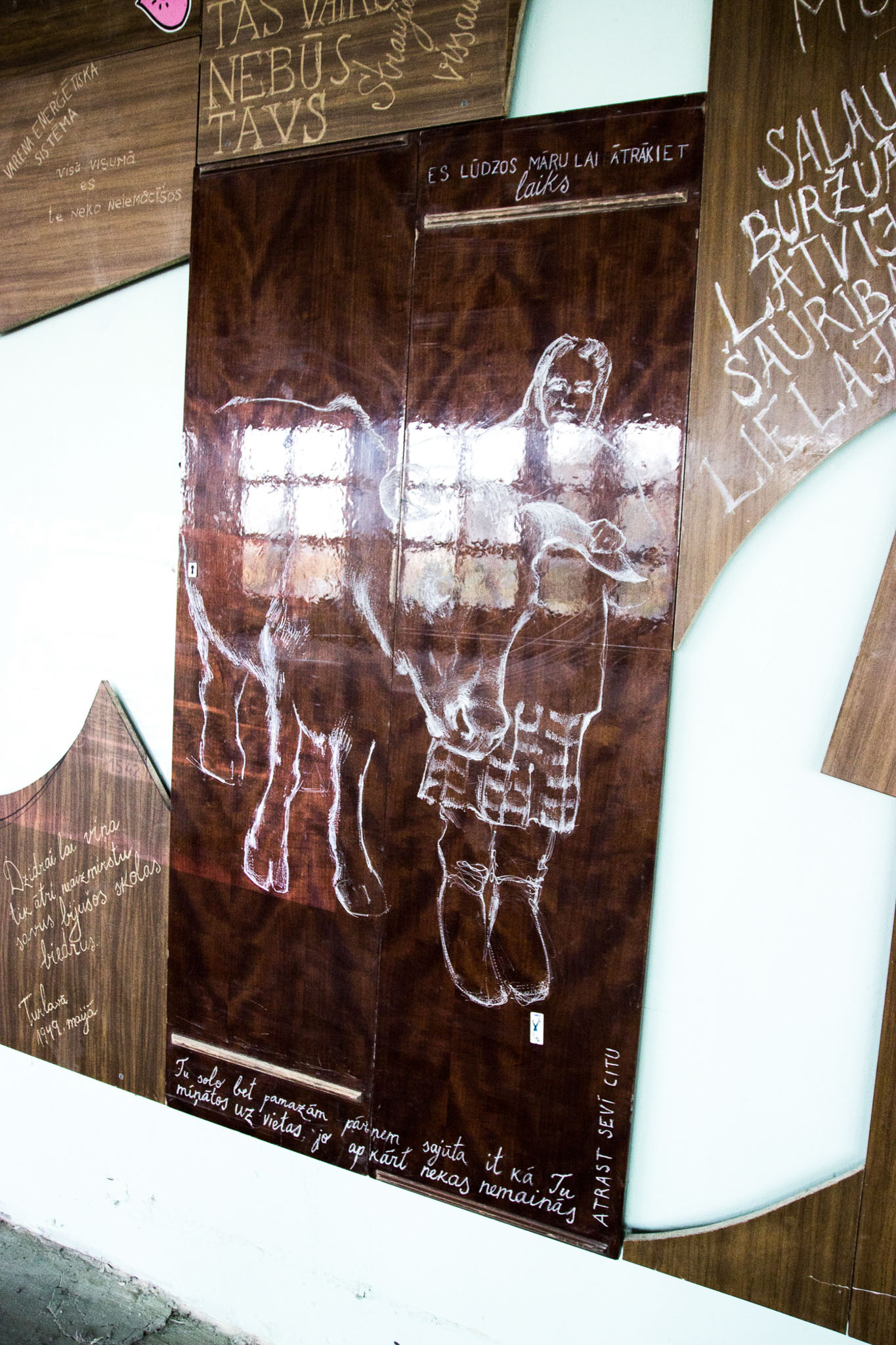
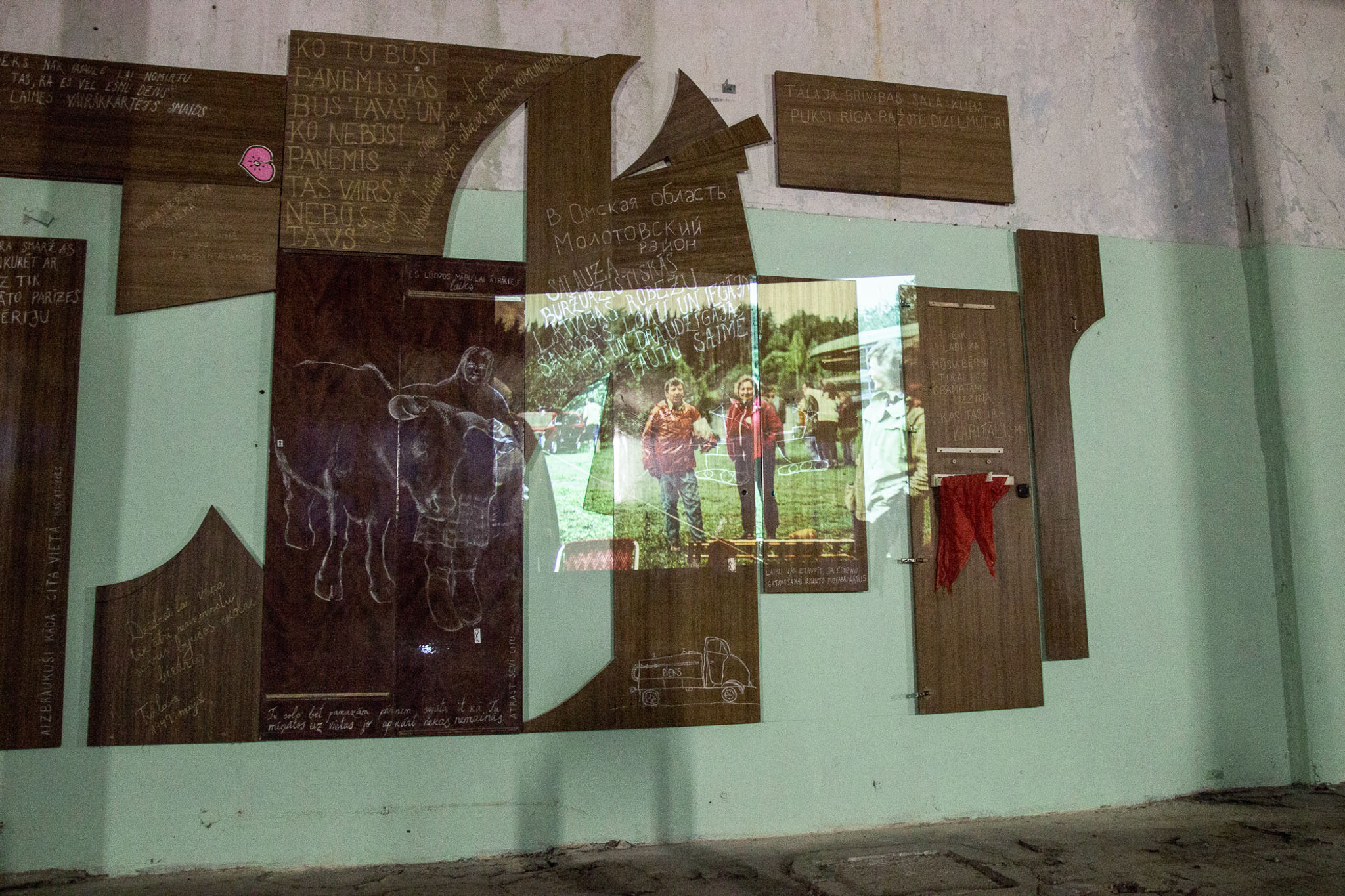
Wall installation, scratch on varnished chipboard, 260 x 400 cm, 2020
Photography: Annemarija Gulbe
Curator: Auguste Petre
The abundance of options in our modern world can be just as confusing as being face with a single choice. In society there is no longer a set of parameters such as “the only one – official – imposed”. Various fragments are becoming increasingly exposed nowadays, and yet there is still a sense of trust in the previous assumptions regarding what is desirable and not. Confusion. It is unwittingly difficult to break free of the past, because society continues to carry-on with the norms and conventions of a collapsed system thus conflicting with the present time.
In 1984 my father was rejected from the Art Academy of Latvia, however later on while serving in the army he has to create the art and posters required for the system while working in the assembly hall of the military club. He hid his denim outfit behind embedded panels in the walls. The panel covers-up gaps and secrets. Behind it there is a forgotten, unrealized history. As a harmless, decorative layer the panels are meant to be a representation of status. Within them, we are able to rapidly approach the sunniest dreams of humanity where “Dzintars” competes with the ever so adored Parisian perfume! People’s lives, experiences and memories have also remained there for a lifetime. We understand that the continuity of it all is to be found in the present.
Text: Annemarija Gulbe

-
The exhibition “Synthesis. Study of the truth through movement, progress and divergence” is a group show of seven Latvian artists born in the 1990s, and is an attempt to promote the return to unexplored concepts and an experiment to impersonate them in a contemporary context.
In the first half of the 20th century, in the so-called western world, parallel to the manifestation of multifaceted and diverse art, some other forms of arts were ruled over by political dictatorships are also emerging, within which visual means of expression are subjected to ideology and serve as powerful instruments of social propaganda. The art of totalitarianism, which is being realized in authoritarian countries, also permeates the history of Latvian art, creating an entirely ambiguous view of its nature, tasks and achievements.
The main direction of the art of totalitarianism in Eastern Europe is socialist realism, whose deceptive formulation seems to have become a difficult riddle for contemporary Latvian art researchers, critics and authors. Perhaps for this reason, the artistic legacy of totalitarianism is often viewed with contempt, in a highly subjective and emotional way. Often, the reasons for this perception lie in personal associations or in inherited memories of the time, so in today’s context, it seems essential to ask – what is it that connects the traditional belief system and the processes of contemporary ideas? Do traditions (including stereotypes) still serve as a basis for developing new ideas, or have they become an opportunity to derive inspiration for new interpretations?
Totalitarianism, in its absolute whole, applies to a certain political ideology, but behind the shell of the concept lies a long path of historical development associated with the idea of totality. The Latin word totus or totalis has been appropriated over time, however it has maintained the idea of totality as a holistic greatness, cohesiveness and fullness. It is very important to acknowledge the relationship between totality and dialectics, the origins of which are often linked to the ideas expressed by Heraclitus of Ephesus, but most directly perceived in the view of Georg Wilhelm Friedrich Hegel’s dialectic philosophy. It was his consideration of totality as a single absolute idea that had inspired the discourse of Karl Marx and Friedrich Engels, and later on Lenin as well. The term “totalitarian system” was first mentioned on 12 May 1923 in the Italian newspaper Il Mondo, in which the publicist, Giovanni Amendola, described it as an absolute political dominance and tyranny over public life. Totalitarianism has been used here as a word game about “political totality.” Two years later, Benito Musolini took over the term entirely and it became the foundation of fascist ideology. With the aim of striving for the perfect future, this concept was also realised in Stalinism.
Text: Auguste Petre



 ANNEMARIJA GULBE